
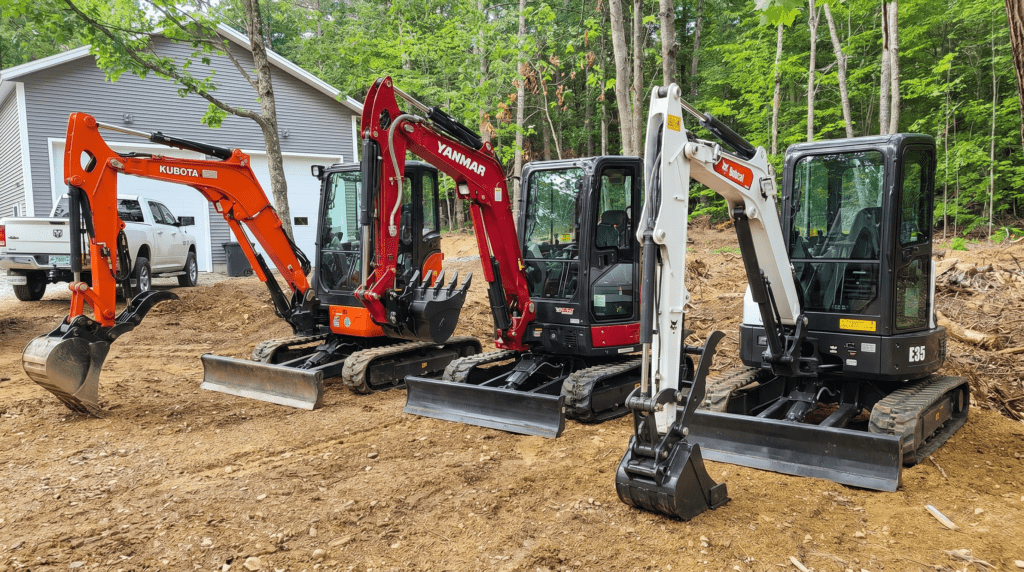
Key Takeaways
- Kubota remains the global and North American volume leader, dominating on sheer dealer network density, engine parts availability, and 3-year resale value retention.
- Yanmar represents the engineering pedigree as the original inventor of the compact excavator, leading the pack in hydraulic efficiency, long-term structural longevity, and true zero tail swing tracking.
- Bobcat delivers the ultimate tool-carrier experience, winning on attachment ecosystem depth, localized North American service density, and aggressive multi-attachment hydraulic coupling systems.
- The Quick Verdict: Pick Kubota for the safest financial asset and easiest parts sourcing.
Choose Yanmar if you are an owner-operator who demands premium hydraulic precision and bulletproof long-term durability.
Select Bobcat if you plan to run a highly versatile fleet built around diverse hydraulic attachments.
When landscape contractors, utility crews, and fleet managers prepare to invest $40,000 to $90,000 into a compact excavation asset, they almost always find themselves staring at three logos: Kubota, Yanmar, and Bobcat.
These three manufacturing giants dominate the global compact equipment market, yet each approaches machine design from a drastically different engineering philosophy.
Choosing the wrong brand can lead to years of frustration, mismatched hydraulic attachment flows, sluggish cycle times, or extended dealer wait times for niche replacement parts.
This head-to-head-to-head review strips away the glossy manufacturer brochures to deliver an honest look from the dealer floor and service bays.
Whether you are looking to understand what is a mini excavator class standard or trying to break a three-way brand tie for your next project purchase, we have compiled the specs, reliability logs, and total cost of ownership (TCO) variables you need to make an informed decision.
How These Three Brands Got Here
To understand why these machines handle material differently, you have to understand their historical DNA.
Kubota established its industrial empire in Osaka, Japan, and holds the title of the global number one manufacturer of mini excavators by volume.
According to recent data from Off-Highway Research, Kubota commands over 23% of the global mini excavator market share.
Kubota built its reputation on manufacturing its own world-class compact diesel engines, creating a vertical integration model that ensures every engine is perfectly tuned to its structural chassis.
Yanmar, also hailing from Japan, is the engineering pioneer of the compact equipment world.
Yanmar invented the world’s first viable compact excavator in 1971 and later patented the industry’s first true Zero Tail Swing (ViO) configuration.
Yanmar approaches equipment production like an boutique engineering firm, focusing heavily on advanced hydraulic matching and heavy-duty casting steel.
While they maintain a smaller, more specialized dealer footprint in North America compared to Kubota, their sub-components are legendary; in fact, Yanmar diesel powerplants are so reliable that they frequently power competitor machinery across the globe.
Bobcat represents the classic American industrial powerhouse, operating out of West Fargo, North Dakota.
Bobcat invented the skid-steer loader and essentially created the modern compact equipment rental fleet model.
When they entered the mini excavator market, they applied their signature strategy: building robust, heavily shielded tool carriers supported by an unmatched domestic dealer network.
Bobcat mini excavators are designed to integrate seamlessly into existing fleets, sharing attachment interfaces with their legendary skid steers and track loaders.
Head-to-Head Specs by Class
Vague brand generalizations do not win contracts or complete trenches.
To see how these machines stack up in the dirt, we must look at direct model-to-model matchups within the two highest-volume size classes in North America.
The 3-Ton Class Matchup: Kubota U35-5 vs Yanmar ViO35-6A vs Bobcat E35 (33-HP)
The 3.5-ton weight class is the industry’s sweet spot, light enough to tow behind a standard standard truck but powerful enough to handle serious utility trenching.
| Technical Specification | Kubota U35-5 | Yanmar ViO35-6A | Bobcat E35 (Long Arm) |
|---|---|---|---|
| Operating Weight | 8,129 lbs | 8,210 lbs | 8,377 lbs |
| Engine Output | 24.8 HP (Kubota) | 24.4 HP (Yanmar) | 33.0 HP (Bobcat/Deutz) |
| Max Dig Depth | 9 ft 10 in | 11 ft 3 in | 11 ft 2 in |
| Auxiliary Hydraulic Flow | 15.8 GPM | 17.4 GPM | 15.0 GPM |
| Tail Swing Configuration | Tight Tail Swing | True Zero Tail Swing | Zero Tail Swing |
| Estimated Base MSRP | ~$54,500 | ~$52,000 | ~$58,000 |
An evaluation of the 3-ton segment reveals an interesting divergence.
For a complete analysis of this specific weight category, see our direct Yanmar ViO35 vs Kubota deep dive.
While the Bobcat E35 boasts higher absolute horsepower, the Yanmar ViO35-6A delivers superior auxiliary hydraulic flow (17.4 GPM), allowing it to cycle attachments faster without stalling the engine.
XCMG and other newcomers are closing price gaps, but these three remain the standard setters.
The 5-Ton Class Matchup: Kubota U48-5 vs Yanmar ViO50-6B vs Bobcat E50
When contractors move into commercial utility construction, commercial footprint layouts dictate moving to a 5-ton platform for structural counterweight balancing.
| Technical Specification | Kubota U48-5 | Yanmar ViO50-6B | Bobcat E50 |
|---|---|---|---|
| Operating Weight | 11,133 lbs | 10,893 lbs | 11,357 lbs |
| Engine Output | 40.4 HP (Kubota) | 39.0 HP (Yanmar) | 49.0 HP (Bobcat) |
| Max Dig Depth | 10 ft 8 in | 12 ft 3 in | 12 ft 8 in |
| Auxiliary Hydraulic Flow | 22.4 GPM | 21.1 GPM | 20.0 GPM |
| Lift Capacity (Over Front) | 4,840 lbs | 4,920 lbs | 4,980 lbs |
If you are actively bidding commercial projects in this class, consult our 3.5-ton vs 5.5-ton mini excavator bidding guide to match project margins to machinery capacities.
In the 5-ton realm, Bobcat utilizes raw platform weight and horsepower to maximize reach, while Kubota optimizes for high auxiliary flow rates directly from the pump handles.
Reliability and Service Network
A mini excavator is a financial asset that only generates revenue when it is operating on a jobsite.
Therefore, dealer density and structural reliability logs are critical evaluation points.
Kubota commands an exceptional service network footprint across North America, with over 1,100 authorized dealerships.
Because Kubota manufactures its own engines, parts sourcing is smooth; you can buy an alternator or water pump at almost any rural dealer hub.
Bobcat matches this domestic strength with over 600 highly specialized construction equipment dealers across the United States.
Their localized service density is phenomenal, and their parts depots are strategically clustered to ensure next-day delivery on critical hydraulic valves and lines.
Yanmar operates on a leaner dealer network framework (~300 locations), but compensates for low dealership density by building machines with extended service lifespans.
For a deeper analysis on their structural design longevity, check our Yanmar compact equipment durability review.
Because Yanmar manufactures the engines for their own machines (and historically supplied engines for John Deere and older Bobcat units), their powertrain reliability is elite.
ReadyDig Service Bay Observation: “When analyzing our internal warranty-claim logs over a three-year window, we noticed a clear pattern.
Kubota units come in most frequently for minor electrical gremlins or broken cabin trim clips, but rarely for major engine failures.
Bobcat units show higher wear on boom pins and bushings if operators neglect daily greasing cycles.
Yanmar units have the lowest overall frequency of structural warranty claims, but if a proprietary hydraulic pilot controller valve fails, parts shipping can take 48 hours longer compared to Kubota’s overnight supply chain.”
— Marcus Vance, Senior Fleet Service Manager at ReadyDig
Operator Experience and Cab Comfort
Operator fatigue directly dictates daily productivity metrics.
If a crew member is uncomfortable, cycle times slow down significantly by hour six of a shift.
Bobcat leads the operator environment category for North American tastes.
Their cabs are spacious, feature high-output HVAC climate control systems, and utilize highly ergonomic suspension seats with adjustable armrests.
Bobcat’s clear sightlines over the boom structure are superior, and their digital display panel integrates machine diagnostics cleanly.
Kubota structures its interior around practical functionality.
The latest KX and U-series dash layouts feature an intuitive jog-dial menu control and a crisp LCD panel.
Visibility is strong, though some operators note that the left-side tracking pedal assembly feels slightly cramped for larger boots.
Yanmar approaches the cab from a strict operational stance.
Their cabins feel slightly tighter compared to Bobcat, but they feature an elite progressive hydraulic control system.
Yanmar’s proprietary hydraulic tuning ensures that multifunction joystick movements—such as simultaneously curling the bucket, extending the arm, and swinging the cab—happen with zero sluggishness or jerky pressure drops.
Resale Value and Total Cost of Ownership
Sticker price is only the first line of the equipment ledger.
Real profit is calculated when the asset leaves your fleet.
According to historical auction data from the Ritchie Bros Market Trends report, 3-year resale value retention percentages break down as follows:
- Kubota: Retains roughly 68-72% of original purchase price at year three, driven by massive secondary-market demand from small contractors and landscaping startups.
- Bobcat: Retains 64-67% of value, benefiting from strong national brand recognition and easy fleet integration.
- Yanmar: Retains 58-62% of purchase price.
While structurally excellent, the lower consumer brand awareness among residential buyers suppresses auction bidding slightly compared to Kubota.
Internal parts cost tracking data from ReadyDig shows that average preventative maintenance kit costs (filters, belts, seals over a 1,000-hour operational cycle) run roughly 12% lower for Kubota than for Yanmar, while Bobcat consumables hover right in the middle.
Kubota’s high component volume drives down the cost of aftermarket maintenance assets globally.
Attachments and Compatibility
If you already run diverse compact tools, attachment integration can make or break your purchasing choice.
To understand how mini excavators stack against compact loaders in tool versatility, read our Toro vs Bobcat comparison framework.
Bobcat holds a massive structural advantage here; their attachment ecosystem is unparalleled.
Their specialized hydraulic exchange couplers let operators swap between augers, breakers, and plate compactors with zero line leakage.
Kubota utilizes a highly reliable quick-coupler system, though swapping non-OEM third-party attachments sometimes requires custom pin-matching adapters.
Yanmar utilizes the Common Industry Interface layout for structural components, but operators must double-check hydraulic pressure relief configurations to avoid seal blowouts on legacy attachments.
For compact track loader comparisons, see our Toro Dingo vs Bobcat MT100 analysis.
When to Pick Each Brand
To simplify your fleet purchasing strategy, follow this direct selection framework:
Choose Kubota if:
- Your project sites span remote rural regions where nearby dealer support is paramount.
- You plan to cycle the machine out of your fleet in 36 months and want maximum resale value retention.
- You want a predictable, simple machine that any mechanic can maintain.
Choose Yanmar if:
- You are an owner-operator executing precision structural digs in tight residential zero tail swing environments.
- You keep equipment for 7,000+ hours and prioritize heavy steel castings over fancy electronics.
- You demand top-tier multi-function hydraulic performance.
Choose Bobcat if:
- You run multiple attachments (breakers, thumbs, flail mowers) on a daily basis.
- You already operate a Bobcat skid steer or track loader fleet and share attachment plates.
- You want maximum cab space and localized North American operator comfort amenities.
Frequently Asked Questions
Which is more reliable: Kubota, Yanmar, or Bobcat?
All three brands are highly reliable, but they exhibit different service profiles.
Yanmar features the lowest overall frequency of major structural component failures due to heavy Japanese steel castings.
Kubota is the most reliable for consistent parts availability, while Bobcat excels at housing heavily shielded hydraulic lines to prevent external jobsite damage.
Does Kubota or Yanmar hold its value better?
Kubota consistently holds its value better in the secondary auction market, retaining roughly 68-72% of its original purchase price after 3 years compared to Yanmar’s 58-62%.
This gap is driven entirely by Kubota’s higher volume brand recognition among residential buyers.
What’s the main difference between a Kubota U35 and a Bobcat E35?
The primary difference lies in powertrain matching and lift paths.
The Bobcat E35 options include a higher horsepower layout (33 HP), making it a powerful attachment platform, while the Kubota U35-5 provides a tighter balance of hydraulic flow control (15.8 GPM) tailored for smooth, low-fatigue utility excavation.
Which mini excavator brand has the best dealer network?
Kubota possesses the largest dealer footprint in North America with over 1,100 authorized locations, closely followed by Bobcat’s construction equipment network of 600+ localized hubs.
Yanmar operates a tighter network of specialized equipment distributors.
Are Yanmar mini excavators harder to get parts for?
Engine parts are exceptionally easy to source because Yanmar engines power thousands of competitor machines.
However, niche proprietary chassis components or electronic layout modules can occasionally take longer to ship compared to Kubota’s overnight North American supply lines.
Which brand has the best attachment ecosystem?
Bobcat wins the attachment showdown convincingly.
Their specialized quick-couplers and deep catalog of severe-duty compact tools make them the premier choice for multi-tool operations.
Final Verdict
The 2026 mini excavator brand showdown proves that there is no single “best overall” machine; there is only the best machine for your specific operational model.
Kubota remains the undisputed king of financial safety and parts distribution.
Yanmar remains the connoisseur’s choice for precise, long-term engineering execution.
Bobcat stands tall as the ultimate localized tool carrier platform.
If you are ready to evaluate these machines head-to-head on your own jobsites, look at our updated ranking of the best mini excavators 2026 across all frame classes.
Ready to scale your commercial fleet numbers? Contact the ReadyDig equipment team today to receive a personalized quote, request rental fleet package rates, or explore our flexible rent-to-own programs.
We will put a configured asset summary in your inbox within 24 hours.