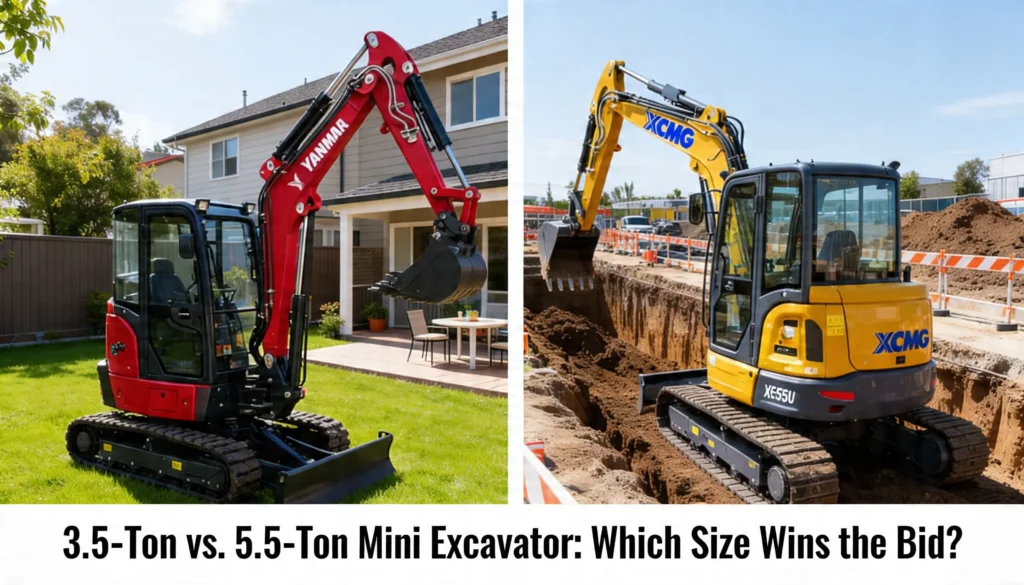
In the heavy equipment industry, guessing on machine size is a fast way to lose money. Bidding a commercial utility job with an undersized machine leads to blown deadlines and exhausted operators. Conversely, bringing a massive machine to a cramped residential backyard guarantees property damage and wasted transport costs. The decision between the two most popular compact weight classes requires precise calculation.
At
ReadyDig, we guide contractors through these critical fleet decisions every single day. If you are debating a
mini excavator vs. standard excavator, you have likely narrowed your focus to the highly versatile 3.5-ton and 5.5-ton categories. This guide provides the definitive, data-driven comparison of both sizes. We will break down specifications, total cost of ownership, and logistical requirements so you can bid smarter, work faster, and ensure your crew is always
Ready. Set. Dig.
The Definitive Spec Comparison: 3.5T vs. 5.5T
To understand the operational gap between these two machines, we must look directly at the hard numbers. Let us compare the industry standard benchmarks typical of machines like the 3.5-ton Yanmar VIO35 and the 5.5-ton XCMG XE55U.
| Specification |
3.5-Ton Class (e.g., Yanmar VIO35) |
5.5-Ton Class (e.g., XCMG XE55U) |
| Operating Weight |
Approx. 7,500 to 8,200 lbs |
Approx. 11,500 to 12,500 lbs |
| Max Digging Depth |
10 to 11 feet |
12 to 15 feet |
| Engine Horsepower |
23 to 25 HP |
40 to 48 HP |
| Auxiliary Hydraulic Flow |
15 to 17 GPM |
20 to 24 GPM |
Max Digging Depth and Reach: When Size Truly Matters
Digging depth is the ultimate limiting factor on any job site. A 3.5-ton machine tops out around 10 feet. If you are digging a standard residential basement egress or laying shallow utilities, this is perfectly adequate. However, municipal water mains and commercial sewer tie-ins often sit 12 to 14 feet below grade. A 5.5-ton machine provides the necessary reach to hit these depths without requiring massive step-down benching, saving you hours of dirt movement.
Lifting Capacity and Breakout Force
Lifting capacity dictates your ability to place heavy concrete structures like trench boxes and manhole covers. A 3.5-ton excavator will struggle to safely lower a 2,000-pound trench box at full extension. The 5.5-ton class offers significantly higher stability and breakout force. This extra weight allows the machine to chew through compacted rocky soil and heavy clay without the tracks lifting off the ground.
Engine Horsepower and Hydraulic Flow Rates
This is a critical content gap that many buyers overlook. The 5.5-ton machine offers nearly double the horsepower of the 3.5-ton model. More importantly, it delivers over 20 Gallons Per Minute (GPM) of auxiliary hydraulic flow. If you plan to run high-demand attachments, the smaller machine will stall out or overheat. The larger machine provides the sustained flow required for maximum attachment performance.
Matching Machine to Application and Project Type
Understanding
how to choose the right excavator size means looking at your most common contracts and matching the iron to the application.
Trenching and Utility Work: Speed and Depth Requirements
For long, uninterrupted commercial utility trenches, the 5.5-ton machine wins effortlessly. Its longer track base provides better grading stability, and the larger bucket capacity means you can move 30% to 40% more cubic yards per hour compared to a 3.5-ton unit. However, if you are trenching for fiber optics in a densely populated suburban neighborhood, the 3.5-ton machine is much more appropriate.
Landscaping and Residential Site Access
The 3.5-ton machine is the undisputed champion of residential contracting. It easily fits through standard 6-foot gate openings. Furthermore, its lighter operating weight significantly reduces the risk of cracking a homeowner’s concrete driveway or destroying expensive turf. When maneuvering around delicate retaining walls and existing landscaping, the nimble 3.5-ton is the safest bet.
Demolition and Heavy Attachment Performance
If your work involves smashing concrete slabs or mulching thick brush, you need the 5.5-ton machine. The 3.5-ton lacks the sheer mass required to absorb the heavy vibrations of a large hydraulic breaker. Using an undersized machine for heavy demolition will lead to premature pin wear and boom fatigue. A 5.5-ton excavator handles the recoil easily, keeping you protected under the
ReadyDig Uptime Guarantee™.
Operational Costs and Financial Justification (TCO)
Purchase price is only one part of the Total Cost of Ownership (TCO). You must evaluate the long-term financial impact of your equipment choice.
Purchase Price, Rental Rates, and Financing Options
A new 5.5-ton excavator will cost significantly more upfront than a 3.5-ton model. Daily rental rates reflect this difference, with the larger machine often costing 20% to 40% more per day. If you only occasionally need deep trenching capabilities, a
heavy equipment rental strategy makes sense. If you are ready to buy, ReadyDig offers incredible deals on
Certified Used Equipment, allowing you to secure a 5.5-ton machine for the price of a new 3.5-ton unit.
Fuel Efficiency and Hourly Operating Costs
A larger engine burns more diesel. A 3.5-ton machine will typically consume about 1.0 to 1.5 gallons per hour under heavy load. A 5.5-ton machine will burn between 1.8 to 2.5 gallons per hour. While this seems like a negative for the larger machine, you must calculate fuel per cubic yard moved. Because the 5.5-ton digs faster and scoops more material per cycle, it is actually more fuel-efficient on massive earthmoving projects.
Long-Term Value: Resale, Depreciation, and TCO
Both size classes hold their value incredibly well in the used market. However, 3.5-ton machines are highly sought after by owner-operators, landscapers, and rental houses. This immense market demand means the 3.5-ton unit often experiences a slightly slower depreciation curve over a 5-year ownership period compared to the heavier commercial 5.5-ton class.
Logistical Challenges: Transport and Permitting
Do not buy a machine that your current fleet cannot legally tow.
Required Truck and Trailer Towing Capacities
Transporting a 3.5-ton machine (roughly 8,000 lbs) plus a standard heavy-duty trailer (3,000 lbs) puts your towing weight right around 11,000 pounds. A modern 3/4-ton or 1-ton pickup truck handles this with ease. The 5.5-ton machine changes the math entirely. Weighing in at over 12,000 pounds, plus a heavier gooseneck trailer, you will exceed 16,000 pounds. This absolutely requires a dually 1-ton truck or a medium-duty commercial hauler.
Regulations and CDL Requirements for Hauling
Once your combined Gross Combination Weight Rating (GCWR) of the truck and loaded trailer exceeds 26,000 pounds, you enter Commercial Driver’s License (CDL) territory. Towing a 5.5-ton machine often pushes contractors dangerously close to this legal threshold. Always verify your setup complies with
FMCSA commercial driving regulations to avoid devastating fines and impoundments.
Site Maneuverability (Zero Tail Swing)
Both 3.5-ton and 5.5-ton models are available in Zero Tail Swing (ZTS) configurations. ZTS ensures the rear counterweight stays inside the width of the tracks while rotating. This is a mandatory feature for residential jobs or single-lane road repairs where swing clearance is nonexistent.
Operator Experience, Comfort, and Technology
A comfortable operator is a highly productive operator.
In-Cab Ergonomics and Standard Features
Because the 5.5-ton machine has a physically larger chassis, the cab interior is noticeably more spacious. Operators with larger builds will appreciate the extra legroom and wider entry doors found in the 5.5-ton class. Both classes now come standard with enclosed cabs, climate control, and ergonomic pilot joysticks, but the premium suspension seats are more commonly standard in the heavier 5-ton tier.
Telematics Systems and Maintenance Diagnostics
Modern fleets live and die by data. Both of these machine classes from top brands like SANY and Yanmar feature advanced telematics. These systems track fuel consumption, idle time, and GPS location. They also send automated diagnostic codes to your phone, ensuring you never miss a service interval and maximizing the lifespan of your investment.
Training Needs and Skill Level Variance
The 3.5-ton machine is incredibly forgiving. It is an excellent platform for training new operators because its movements are smooth and less intimidating. The 5.5-ton machine requires an experienced hand. Its aggressive breakout force and rapid hydraulic response can easily snap utility lines or damage structures if the operator lacks precision and experience.
Frequently Asked Questions
What is the primary advantage of choosing a 5.5-ton mini excavator over a 3.5-ton model?
The primary advantage is significantly greater lifting capacity and digging depth (often reaching 12 to 15 feet), making the 5.5-ton model much more efficient for larger foundations, tougher soil conditions, and handling heavier attachments like hydraulic breakers.
How does the transportation of a 5.5-ton excavator compare to a 3.5-ton model?
A 3.5-ton machine can usually be towed by a heavy-duty pickup truck with a standard trailer. A 5.5-ton machine and its required trailer often exceed the weight limits of a standard commercial pickup, potentially requiring a 1-ton truck and strict attention to CDL regulations.
Which machine, the 3.5-ton or 5.5-ton, is better for residential backyard access?
The 3.5-ton model is generally superior for residential areas because it has a narrower profile and is easier to maneuver in confined spaces with less risk of surface damage than the larger 5.5-ton unit.
How much deeper can a 5.5-ton mini excavator dig compared to a 3.5-ton model?
A typical 5.5-ton (or 6-ton class) mini excavator can dig trenches up to 12 to 15 feet deep, which is significantly deeper than the typical 8 to 10 foot reach of a 3.5-ton machine.
Are the daily rental rates significantly different between the 3.5-ton and 5.5-ton classes?
Yes, the daily rental rate for a 5.5-ton machine is usually 20% to 40% higher than the rate for a 3.5-ton machine, reflecting the higher purchase price, greater horsepower, and increased operational capability.
How does the breakout force differ between these two weight classes?
The 5.5-ton machine has substantially higher breakout force due to its greater operating weight and engine power, which translates to faster cycle times and better performance when digging in hard clay, rock, or frozen ground.
Can a 3.5-ton excavator adequately run a high-flow hydraulic attachment like a mulcher?
Many 3.5-ton models have limited auxiliary hydraulic flow rates, which may restrict the performance of high-demand tools like large hydraulic mulchers or breakers. The 5.5-ton unit typically offers higher flow hydraulics necessary for optimal high-performance attachment use.
Which mini excavator size is more fuel efficient?
The lighter 3.5-ton machine is typically more fuel-efficient in terms of gallons per hour compared to the 5.5-ton model, though the larger machine may be more fuel-efficient per cubic yard of material moved on large, heavy-duty projects.