
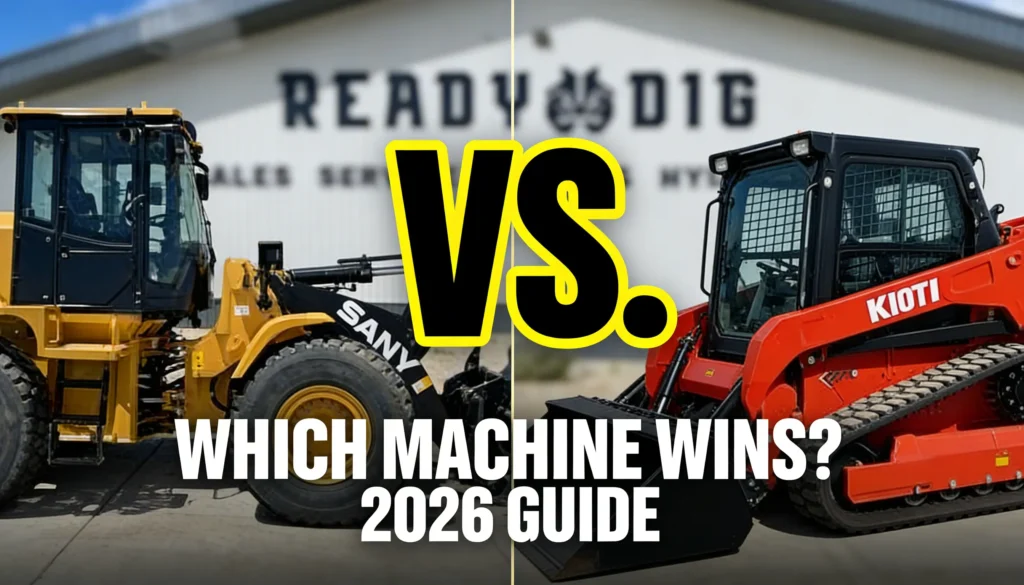
It’s the classic job site debate: Do you need the agility of a skid steer or the efficiency of a wheel loader? If you choose the wrong machine, you risk tearing up your client’s turf, burning through your tire budget, or worst of all getting stuck with a load you can’t lift high enough to dump.
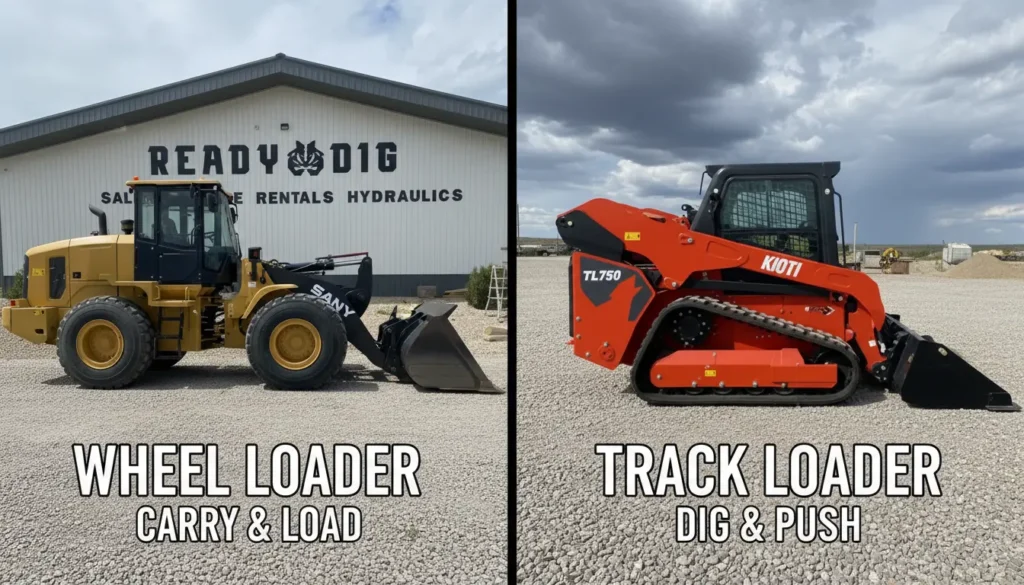 At ReadyDig, we see this decision come down to one simple mental model: The “Agility vs. Carry” Rule.
At ReadyDig, we see this decision come down to one simple mental model: The “Agility vs. Carry” Rule.
- Skid Steers / CTLs are for agility, tight spaces, fast short-cycle work, and maximizing attachment versatility.
- Compact Wheel Loaders are for carrying, efficient loading, smoother travel across large sites, and reducing surface scuffing in many conditions.
The Core Difference: Mechanics & Maneuverability
What is a Skid Steer?
A skid steer (or Compact Track Loader/CTL if it has tracks) turns by “skidding.” It locks one side and powers the other, allowing it to pivot in its own footprint. This zero-turn capability makes it a go-to for confined spaces, tight residential work, and tasks where frequent repositioning is unavoidable. They typically range from 2,800 to 11,600 lbs. Check out our Compact Loaders for Rent to see current models available.What is a Compact Wheel Loader?
A compact wheel loader uses articulated steering the machine bends in the middle. Because the rear tires closely follow the front tires’ path, it typically reduces scrubbing compared to skid turning. They range anywhere from 6,000 lbs up to massive 250,000 lb production loaders, offering superior lift height and transport speeds up to 25 mph. Browse our Wheel Loaders for Sale including the latest high-efficiency XCMG models.1. The Real Total Cost of Ownership (TCO) & Depreciation
While the sticker price is the first thing buyers notice, the Total Cost of Ownership (TCO) tells the real story over a 1,000+ hour lifespan.- Upfront & Resale Value: New skid steers typically range from $25,000 to $65,000, while wheel loaders demand a much higher investment of $40,000 to $200,000. However, skid steers depreciate significantly; used models often drop to roughly half the price of a new machine. Wheel loaders historically hold their resale value much better after 5 years.
- Fuel Burn: Skid steers generally run at higher throttle levels constantly to power hydrostatic pumps, which results in lower fuel efficiency and higher daily operating costs. In contrast, modern wheel loaders often utilize throttle management systems that only increase engine power under heavy loads, providing much better fuel economy.
- Tire and Track Wear: The skidding motion used to turn a wheeled skid steer causes rapid tire wear, especially on harsh surfaces like asphalt. Compact track loaders (CTLs) avoid tire wear but come with high track and undercarriage maintenance costs. Wheel loaders experience more even, rolling tire wear, though replacing their massive tires is a significant expense when the time comes.
2. Operator Fatigue, Ergonomics, and Safety
Productivity plummets when an operator is exhausted or fighting poor visibility.- Fatigue & Cab Space: Skid steer cabs are notoriously cramped with a compact seat and control layout, which easily leads to operator fatigue during prolonged operation. Wheel loaders, on the other hand, provide spacious cabs, air-ride seating, and a much higher degree of operating comfort, which is crucial for long 8-hour shifts.
- Visibility & Blind Spots: Because the engine of a skid steer is usually mounted directly behind the operator, visibility to the sides and rear is notably reduced, creating significant blind spots. Wheel loaders offer a higher seating position surrounded by 360-degree glass, which greatly reduces visual obstructions and improves overall site safety.
- Rollover Risks: While the small, enclosed space of a skid steer keeps the risks of collisions relatively controllable, wheel loaders inherently have a much greater tipping load, longer reach, and wider stance. This structural advantage allows wheel loaders to lift and transport heavy materials with a significantly lower risk of rolling over.
3. Mastering Specific Terrains
You cannot force a machine to perform on the wrong surface. The specific terrain of your job site dictates the winner:- Mud, Swamps, and Rugged Mountains: Tracked skid steers (Compact Track Loaders) are the undisputed champions here. Their tracks increase ground contact area and independently distribute traction, preventing slippage in complex and unstable terrains.
- Flat, Paved, and Hard Surfaces: Wheel loaders thrive on highways, paved construction sites, and open material yards. However, their single drive axle makes them prone to localized slippage, resulting in poor off-road capability when facing deep ditches or soft, muddy dirt.
- Turf and Delicate Landscaping: If you are driving over grass or finished pavers, a wheeled mini loader with articulated steering is the best choice. Unlike skid steers that tear up the ground, articulated wheeled loaders glide across surfaces with minimal turf damage.
4. The Red Tape: Transport and Licensing
Logistics can be a nightmare if you purchase a machine you cannot easily move.- Transportability & Permits: Skid steers are highly portable. Their compact design means they can fit on standard equipment trailers and be towed behind a 3/4-ton pickup truck. Wheel loaders are a completely different beast. Moving a wheel loader often requires specialized heavy-haul trailers and potentially special oversize road transport permits, depending on the model’s width and weight.
- Licensing Constraints: The sheer size of heavy machinery can be intimidating. Operating these massive machines can sometimes make it feel like you need a “Class A CDL” just to get behind the wheel of your tow rig. Furthermore, if you plan to drive a high-speed wheel loader (which can reach 25 mph) on public roads between sites, you will likely face local DOT licensing and road registration requirements that do not apply to a skid steer that never leaves the dirt.
Decision Matrix: Which Should You Choose?
| Scenario | The Winner | Why? |
|---|---|---|
| Tight Residential Backyards | Skid Steer / CTL | Zero-turn radius and narrow width fit through gates. |
| Loading High-Sided Dump Trucks | Wheel Loader | Superior hinge-pin height and forward reach. |
| Snow Removal (Large Lots) | Wheel Loader | Top speed of 25mph, higher stacking capacity, and great visibility. |
| Running Complex Attachments | Skid Steer / CTL | High-flow hydraulics support mulchers, trenchers, and augers. |
| Finished Turf & Pavers | Wheel Loader | Articulated steering prevents tire scrubbing and surface damage. |
| Deep Mud & Slopes | Track Loader (CTL) | Rubber tracks provide maximum flotation and traction. |
Still Undecided? Try Before You Buy.
Specs on a screen are useful, but nothing beats seat time. At ReadyDig, we offer a Rent-to-Own (RPO) program where your rental payments can apply toward ownership. Put the machine to work, confirm it fits your projects, then decide. Plus, eligible equipment is backed by our Uptime Guarantee™: we’ll be on-site within 24 hours, and if it’s not fixed, we’ll deliver a loaner within 72 hours so you can keep your schedule moving.Contact ReadyDig Today for a Quote