
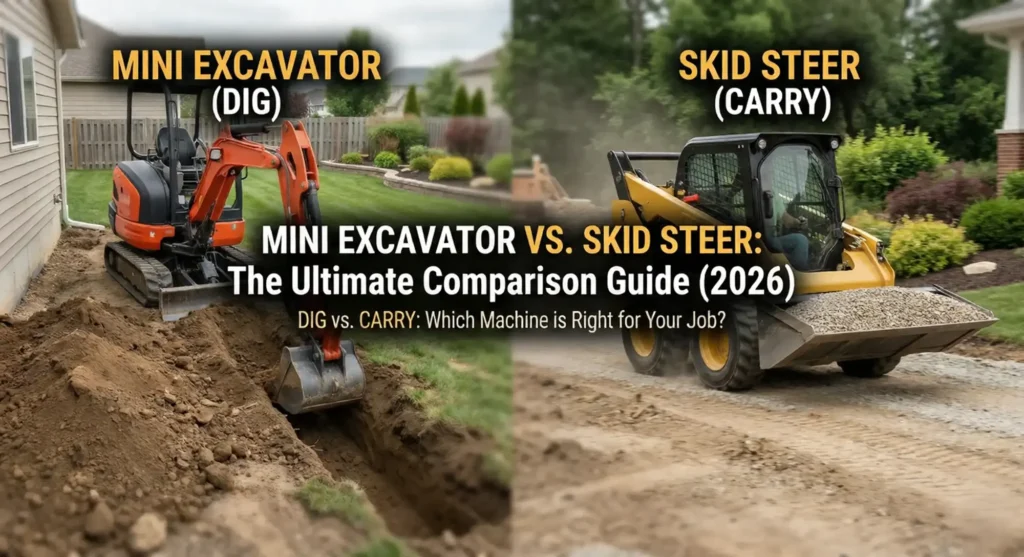
If you have a project that involves moving dirt, lifting heavy materials, or digging trenches, you are likely debating between two industry heavyweights: the mini excavator and the skid steer (often referred to today as a compact track loader (CTL) when it’s on tracks).
At a glance, they might seem interchangeable both are compact, powerful, and trailer-friendly. But choosing the wrong one can turn a weekend job into a week-long headache.
A skid steer can move material fast, but it can’t dig a clean trench with the same precision.
A mini excavator digs deep and accurate, but it’s not built to carry material across a site efficiently.
This guide breaks down the “Dig vs. Carry” rule, cost differences, safety factors, and logistics to help you make the right choice for 2026.
The Short Answer: Speed vs. Precision
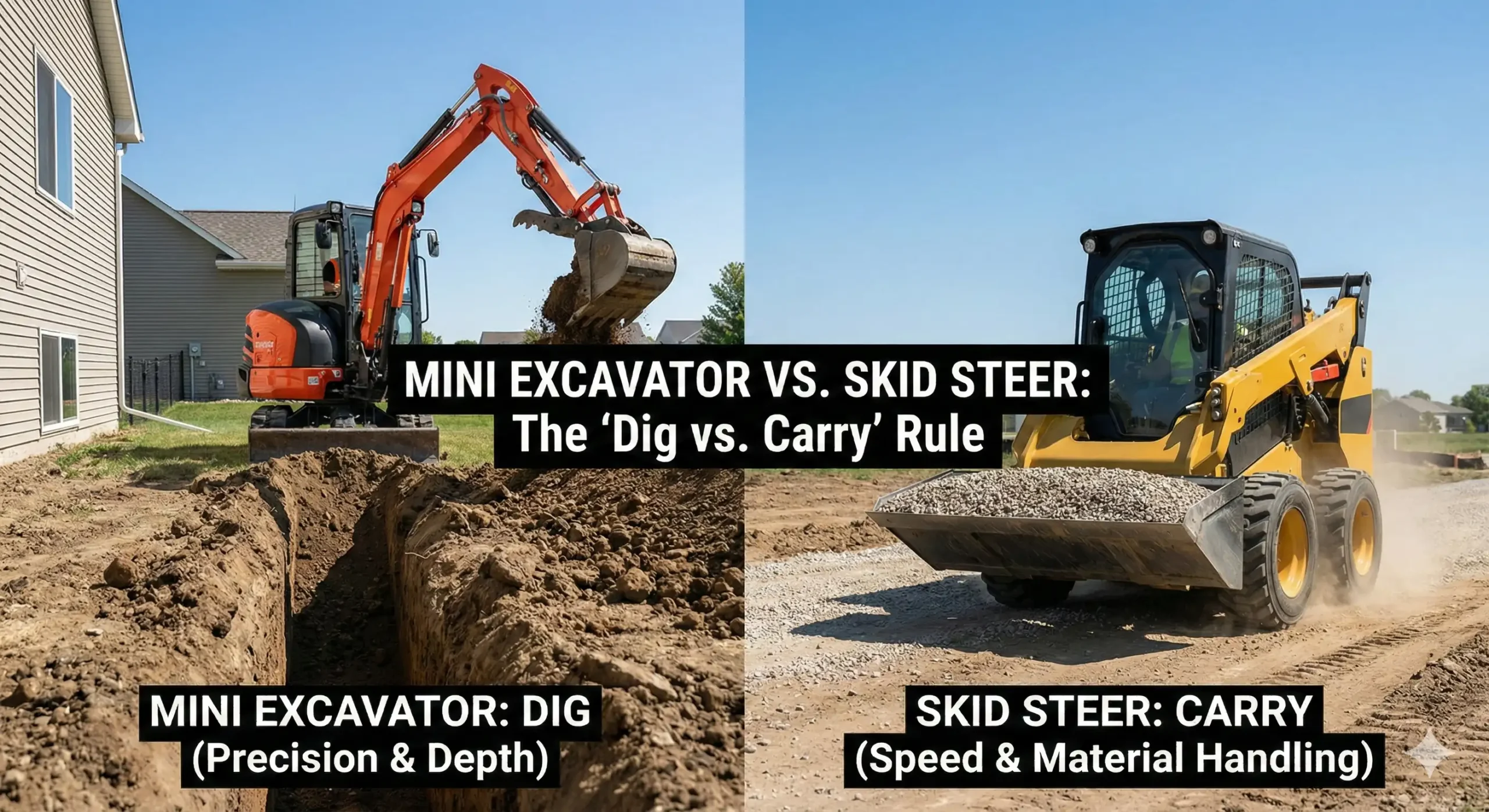
If you’re in a rush, here’s the quick decision matrix:
- Choose a Skid Steer / Track Loader if: Your main goal is moving material (soil, gravel, snow) quickly from Point A to Point B, grading a driveway, sweeping a site, or loading a truck.
- Choose a Mini Excavator if: Your main goal is digging below grade (trenches, pools, stumps) or working in tight spaces where you need 360° rotation without constantly repositioning the machine.
ReadyDig tip: The most efficient jobs often follow a simple combo: mini excavator digs, skid steer carries. If you’re doing both tasks all day, renting both can be cheaper than losing days to slow workflow.
What is the Difference? Definitions and Core Functions
What is a Mini Excavator?
A mini excavator is defined by its 360-degree rotating house and its hydraulic boom/arm setup.
It sits on tracks (usually rubber) and is designed to reach down and out.
Because the house rotates while the tracks can stay stationary, it delivers excellent precision, especially in confined areas.
What is a Skid Steer?
A skid steer loader (and most CTLs) uses lift arms mounted beside the cab and a rigid frame.
It turns by “skidding” (driving one side faster than the other).
Its primary force is exerted forward (pushing) and up (lifting), making it a high-speed material-handling machine.
Browse our inventory of compact track loaders for sale.
Head-to-Head Comparison
1. Digging Capability
Winner: Mini Excavator
Yes, you can add a digging attachment to a skid steer, but trench visibility and control are limited.
A mini excavator like the XE35U is purpose-built to dig.
It can reach 10+ feet (depending on model), cut vertical trench walls, and work cleanly around utilities with far better control.
2. Material Handling & Speed
Winner: Skid Steer
This is where loaders shine. A skid steer/CTL can travel around 7–10 mph, while a mini excavator typically crawls near 2–3 mph.
If your job is moving mulch, gravel, or spoils across a site, a skid steer can easily be several times faster.
3. Versatility & Attachments
Winner: Skid Steer (The “Swiss Army Knife”)
The skid steer/CTL mounting plate is one of the most flexible attachment systems on a jobsite. Common options include:
Mini excavators also run excellent tools (breakers, augers, thumbs), but their attachment ecosystem is typically more focused on earthwork and demolition than high-speed material handling.
4. Turf Damage and Ground Pressure
Winner: Mini Excavator
If you’re working on a finished lawn, a mini excavator is usually safer.
Its tracks distribute weight more evenly, and because the upper house rotates to dump, the tracks often move less.
A skid steer must skid to turn, which creates friction and can tear up turf quickly especially on dry grass or delicate landscaping.
Safety & Ease of Use (Learning Curve)
For DIYers and new operators, machine “feel” matters almost as much as specs:
- Skid Steers (Steeper learning curve): Skid steers can feel “jumpy,” especially to new operators. They also have larger blind spots to the rear and sides due to the lift arms and loader geometry.
- Mini Excavators (Easier for precision): Coordinating boom/stick/bucket takes practice, but mini excavators are generally stable and offer excellent visibility. The ability to rotate in place helps keep the work controlled, especially on tight residential sites.
Important Logistics: Towing and Site Access
Before you rent, confirm you can legally and safely move the machine to your site.
Towing Requirements
- Mini Excavators (1–3 tons): Often towable by a half-ton pickup (e.g., Ford F-150) if the combined trailer + machine weight stays within your truck’s tow rating and the trailer is properly equipped.
- Skid Steers / CTLs (3–5 tons): These are deceptively heavy. Many units weigh 7,000–9,000 lbs (or more). You typically need a ¾-ton truck (F-250/2500) and a heavy-duty trailer with brakes to transport them safely and legally.
Site Access (The Gate Test)
Most residential gates are about 36–48 inches wide. Many 1-ton minis have retractable tracks that narrow to around 39 inches, allowing backyard access. Most skid steers/CTLs are 60+ inches wide and may require a double gate or fence panel removal.
Cost Analysis: Rental, Ownership & Resale
Rental Rates
Rates are often comparable, with skid steers sometimes slightly cheaper per day:
- Skid Steer Rental: ~$250–$600 per day
- Mini Excavator Rental: ~$300–$700 per day
Check current availability on our rental page.
If you’re considering ownership but want to reduce risk first, ReadyDig offers a rent-to-own option (rent-to-purchase). You can put a machine to work, confirm it fits your jobs, then apply payments toward ownership.
Operating Costs & Resale Value
If you are buying, consider long-term ownership costs not just price:
Maintenance: Skid steer tires wear quickly on asphalt (cheaper to replace).
Mini excavator tracks often last longer, but replacement can be a larger expense when it’s time.
Resale Value: Mini excavators commonly hold value well due to high demand for residential and utility work.
High-hour skid steers can be perceived as “worked hard,” which can soften resale pricing depending on condition and service records.
Downtime (the hidden cost): A machine sitting idle can erase savings fast.
Dealer-backed support matters especially for contractors running tight schedules.
For eligible equipment, ReadyDig’s Uptime Guarantee is designed to reduce downtime risk and protect project timelines.
Frequently Asked Questions
Which is better for digging: a mini excavator or a skid steer?
A mini excavator is significantly better for digging. It offers greater depth, reach, and precision for trenching, foundations, and below-grade work.
Can I use a skid steer to dig a trench?
Yes, but you’ll usually want a dedicated trencher attachment. Trenching with a standard bucket is typically inefficient and imprecise.
Is a mini excavator easier to transport than a skid steer?
Generally, yes. Smaller mini excavators are lighter and narrower. Many skid steers/CTLs require heavier trailers and larger tow vehicles due to weight.
Which machine causes less damage to lawns?
A mini excavator usually causes less damage because it has lower ground pressure and doesn’t need to skid-turn the way a loader does.
Can a mini excavator load a dump truck?
Yes, but it’s typically slower than a skid steer due to smaller bucket capacity. However, a mini can be effective if the truck is positioned appropriately and you prioritize controlled loading over speed.
Conclusion
The choice comes down to the mechanics of your job.
If you are digging a trench, hole, or pool, rent the Mini Excavator. If you are moving the material coming out of that excavation, grading, or loading quickly, rent the Skid Steer.
For large landscaping projects, the fastest (and often cheapest) workflow can be renting both or working with a contractor who has the right fleet.
Need help sizing your machine? Contact the ReadyDig team for expert advice and a quote for your next rental or purchase.