
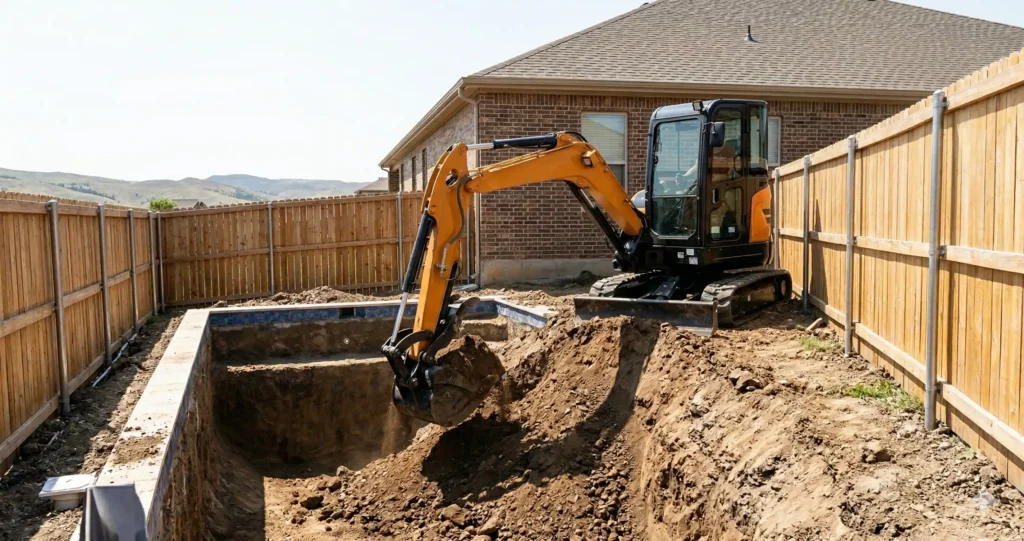
Installing a backyard swimming pool is a massive undertaking that requires precision, planning, and serious earthmoving power. While massive commercial excavators are great for clearing open land, they are usually too large, too heavy, and too destructive to bring into a finished residential neighborhood. This is exactly where the mini excavator shines.
At ReadyDig, we constantly help contractors and ambitious homeowners select the perfect equipment for common backyard projects and renovations. Digging a pool is not just about carving a hole in the ground. It requires strict adherence to depth regulations, careful contouring of slopes, and a strategic plan for removing hundreds of cubic yards of dirt. In this guide, we will break down exactly how to dig a pool using a mini excavator, how to choose the right machine size, and how to keep your project on track and on budget.
Feasibility and Planning: Can a Mini Excavator Dig My Pool?
Before you break ground, you must determine if a compact machine is the right tool for your specific pool dimensions and site conditions.
Mini vs. Standard Excavator: The Size and Depth Challenge
When looking at an excavator vs. mini excavator, a standard full-size machine can dig a pool incredibly fast, but it requires wide access gates, heavy-duty transport, and plenty of swing clearance. A mini excavator offers a smaller footprint and rubber tracks that protect existing driveways and landscaping. However, the trade-off is maximum digging depth. A standard 3-ton mini excavator might max out at a 10-foot digging depth. If your pool design includes an 8-foot deep end, you need to ensure the machine you rent has the reach and breakout force to handle compacted soil at that depth without struggling.
Residential Permits and Noise Ordinances
You cannot simply start digging a massive hole in a residential neighborhood. You must secure the proper permits from your local municipality. Furthermore, you must call 811 to have all underground utilities (gas, water, electrical) clearly marked before you start. Finally, consider local noise ordinances. Modern mini excavators are significantly quieter than older full-size machines, which keeps you in compliance with residential noise limits during early morning or late afternoon shifts.
Choosing the Right Mini Excavator Size and Power
Renting an undersized machine is the number one reason pool projects fall behind schedule. Learning how to choose the right excavator size ensures you have the proper combination of weight, power, and reach.
Matching Operating Weight to Pool Depth and Dimensions
For a standard above-ground pool leveling job or a very small plunge pool, a 3-ton to 4-ton mini excavator will easily get the job done. However, for a standard 16×32 foot in-ground pool with an 8-foot deep end, you should upgrade to a 6-ton to 10-ton machine. These larger midi excavators provide the necessary hydraulic breakout force to chew through hard subsoil and the lifting capacity to hoist heavy loads of wet clay out from the bottom of the deep end.
Key Specs: Digging Depth, Reach, and Lifting Capacity
Always review the spec sheet of the machine before finalizing your rental or purchase. Pay attention to the maximum digging depth (it should comfortably exceed your pool’s deepest point by at least two feet to account for the gravel base). Evaluate the horizontal reach, which dictates how often you will need to reposition the machine. Lastly, confirm the lifting capacity. When you are lifting a bucket full of dense rock from 8 feet down, you do not want the machine tipping forward.
The Step-by-Step Pool Excavation Process
Digging a pool requires a methodical approach to prevent wall collapses and ensure accurate gradients.
Site Marking and Ground Preparation
Begin by using marking paint and stakes to outline the exact perimeter of the pool, adding an extra two feet around the edges for the over-dig (which is necessary for plumbing and formwork). Establish a laser level benchmark to ensure your depth measurements remain perfectly accurate throughout the digging process.
Digging the Shallow End and Slopes
Start your excavation at the shallow end. This gives you a ramp to track the machine in and out of the hole if necessary. Dig down to the required depth of the shallow end, ensuring the floor is perfectly level. Once the shallow end is established, begin carving out the transition slope that leads down to the deeper section of the pool.
Excavating the Deep End and Hopper
The deep end (often called the hopper) is the most challenging part of the dig. You will be dealing with harder soil and a limited line of sight. Reposition your machine carefully and work your way down. It is highly recommended to leave a dirt ramp until the very end so you can safely drive the excavator out of the hole.
Final Grading and Contouring
Once the bulk of the dirt is removed, switch to a smooth-edged grading bucket. This allows you to sculpt the final contours of the pool walls and floor with precision, removing any loose material and creating a firm, undisturbed base for the concrete shell or vinyl liner.
Estimating Project Duration and Costs
Productivity Benchmarks: Time Estimates for Pool Excavation
How long will this actually take? If you are excavating a standard 16×32 foot pool in normal loamy soil using a 6-ton to 8-ton mini excavator, an experienced operator can finish the rough dig in 8 to 12 hours. However, if you are a novice operator, or if you encounter heavy clay and rock, you should budget two to three full days for the excavation phase. Always build a buffer into your schedule, whether you are planning a heavy equipment rental or buying the machine outright.
Transportation and Spoils Removal Logistics: The Dig vs. Carry Rule
Here is the secret that professional contractors know: removing the dirt from the yard takes longer than digging the hole. A 16×32 pool will generate well over 100 cubic yards of loose dirt (often called spoils).
To maximize efficiency, apply the ReadyDig Dig vs. Carry rule. Your mini excavator should stay planted in one spot strictly to dig the hole. You should rent a separate compact track loader (check our mini excavator vs. skid steer comparison for details) to act as your carry machine. The track loader takes the dirt directly from the excavator’s bucket and shuttles it out to the dump trucks waiting on the street. This dual-machine strategy cuts your total project time in half.
Essential Attachments for Pool Building
Using the standard bucket for the entire project will slow you down. You need specialized tools from the ReadyDig attachment inventory.
Selecting the Right Bucket (Digging and Grading)
You need a heavy-duty digging bucket equipped with teeth to break through the hard topsoil and clay layers. Once you reach your target depth, you must switch to a toothless grading bucket (also known as a ditching bucket). The grading bucket allows you to shave the walls perfectly smooth without gouging the earth, which saves hours of manual shovel work.
Dealing with Rock and Hard Clay (Hydraulic Breakers)
If you hit a layer of solid rock or highly compacted clay, your digging bucket will bounce right off. You will need to utilize a hydraulic breaker attachment to shatter the rock into manageable pieces before scooping it out. All ReadyDig machines are fully compatible with heavy-duty breakers, and our fleet is backed by the ReadyDig Uptime Guarantee™, ensuring your equipment performs flawlessly even in the toughest ground conditions.
Frequently Asked Questions
How deep can a mini excavator dig for a pool foundation?
The digging depth varies significantly, but common rental mini excavators (3 to 4 tons) can typically achieve depths between 8 and 12 feet, with the largest mini class (6 to 10 ton) reaching up to 15 feet.
How long does it take to excavate a residential pool using a mini excavator?
For standard residential dimensions, pool foundation excavation can take as little as a few hours up to one full day, depending on the machine size, operator skill, and ground conditions.
What size mini excavator is required to dig a swimming pool?
For typical residential pools with an 8 to 12 foot deep end, a larger mini excavator in the 6 to 10 ton class is recommended for the necessary digging depth and lifting capacity, compared to smaller 1 to 2 ton models.
What attachments are essential for digging and shaping a pool?
Essential attachments include trenching or digging buckets for the main excavation and a dedicated grading or ditching bucket for final shaping and contouring the pool slopes.
Is it faster to dig a pool with a mini excavator or a standard excavator?
While a standard excavator is much faster at moving large volumes of dirt quickly, a mini excavator is often faster overall for residential pool projects because it saves significant time on transport, setup, and maneuvering in confined backyard spaces.
What are the main limitations of using a mini excavator for pool digging?
The primary limitations are restricted digging depth (maximum usually 15 feet) and lower load capacity compared to full-sized machines, meaning they may struggle with extremely deep pools or very tough, rocky ground.
How much does it cost to rent a mini excavator per day for a project like a pool?
Daily rental costs for a standard 3,000 to 5,000 lb mini excavator typically range from $250 to $400, not including delivery fees, fuel, or the required damage waiver. Larger machines required for deep pools will cost more.
Does the operator’s skill affect the time needed to dig a pool?
Yes, operator skill is a critical factor. An experienced operator can efficiently maintain the correct slopes and depth, preventing the time lost from repositioning and re-digging that a novice operator might require.