

In the dirt world, a broken machine doesn’t just cost you the price of a part it costs you operator wages, project delays, and a blown timeline. Unscheduled downtime is the fastest way to kill a contract’s profitability in 2026. Period.
At ReadyDig, we know that keeping a mini excavator digging or a wheel loader carrying comes down to one simple habit: the daily walk-around. Proactive maintenance is the difference between a minor fluid top-off at 6:00 AM and a catastrophic hydraulic failure at 2:00 PM.
Whether you own a fleet of XCMG loaders or you are renting a Toro Dingo for the week, this guide breaks down the 5 essential daily checks you need to maximize uptime, protect your investment, and slash your Total Cost of Ownership (TCO).
Why Proactive Daily Maintenance Is Your Highest ROI Strategy
Reducing Unscheduled Downtime and Emergency Costs
Reactive maintenance waiting until something breaks to fix it costs roughly three to four times more than proactive maintenance. An emergency hose replacement means paying expedited shipping, emergency field mechanic rates, and eating the cost of idle crew time. A 5-minute pre-shift inspection catches that frayed hose while the machine is still in the yard.Tying Daily Checks to Long-Term Asset Value and Resale
The math is simple but brutal. If you run a skid steer without greasing the pins, the metal-on-metal friction will destroy the structural integrity of the lift arms. Diligent daily maintenance stabilizes your operating budgets and preserves resale value. Over a 5-year lifespan, a well-maintained machine can save you over $150,000 in TCO (repair costs, fuel efficiency, and depreciation) compared to a neglected one. If you’re looking to upgrade, well-maintained machines fetch top dollar when trading up to our new equipment for sale.The Core 5-Point Daily Pre-Shift Checklist for All Heavy Machinery
Before the key even turns in the ignition, every operator must complete this 5-point inspection.Check 1: Fluid Levels and Leak Inspection (Engine, Hydraulic, Coolant)
Heavy equipment lives and dies by its fluids. Pull the dipsticks. Check the engine oil, hydraulic fluid, coolant, and Diesel Exhaust Fluid (DEF). Look under the machine for fresh puddles. A slow hydraulic leak doesn’t just waste expensive fluid; it introduces air and dirt into a highly pressurized system, which can destroy the pump.Check 2: Hoses, Belts, and Electrical Connections
Inspect the hydraulic hoses for dry rot, bubbling, or chafing against metal edges. Check the engine belts for proper tension and cracking. Ensure battery terminals are tight and free of corrosion. Modern tier-4 final engines rely heavily on electrical sensors; a loose wire can throw a fault code and shut down your machine.Check 3: Undercarriage, Tracks, and Tire Pressure
For tracked machines like mini excavators, clear packed mud and rocks from the sprockets and idlers to prevent track derailment. Check the track tension the physics of track tensioning dictate that a loose track will slip, while a track that is too tight will prematurely destroy the undercarriage bearings. For wheeled machines, verify tire pressure to ensure even wear and safe lifting capacity.Check 4: Safety Features and Operator Cab Readiness
Safety is non-negotiable. Test the backup alarms, horn, and all work lights. Ensure the ROPS/FOPS (Roll-Over/Falling Object Protective Structure) has no structural damage. Check the cab windows for visibility, clear out trash that could block the pedals, and verify the fire extinguisher is charged. Tip-over risks increase drastically if the operator can’t clearly see their surroundings.Check 5: Attachments, Pins, and Structural Wear
An excavator is only as good as its bucket. Check the attachment points. Grease all pivot pins and bushings daily to push out dirt and moisture. Look for hairline cracks on the boom, arm, or attachment bracket. Ensure bucket teeth are secure and not worn past their useful life. Need replacement teeth or filters? Hit up our Parts and Services department to keep your fleet running.Going Beyond Daily: Scaling Your PM Schedule
Daily checks are the foundation, but a true Preventive Maintenance (PM) program scales up based on engine hours (250-hour, 500-hour, and annual intervals).Seasonal Adjustments: Modifying Your Daily Checks for Extreme Weather
You can’t treat a machine in July the same way you treat it in January. In the summer heat, your daily check must hyper-focus on clearing the radiator fins of debris to prevent hydraulic overheating. In freezing winter conditions, prioritize battery health (cold cranking amps drop in the cold) and ensure you are using winter-blend diesel to prevent fuel gelling.Maintenance Nuances for Used Equipment: What to Inspect More Closely
If you are running older machines from our Used Equipment inventory, pay extra attention to hydraulic cylinder seals for weeping, and listen closely to the swing bearing on excavators. Older machines have settled in, so catching minor wear before it turns into major metal fatigue is critical.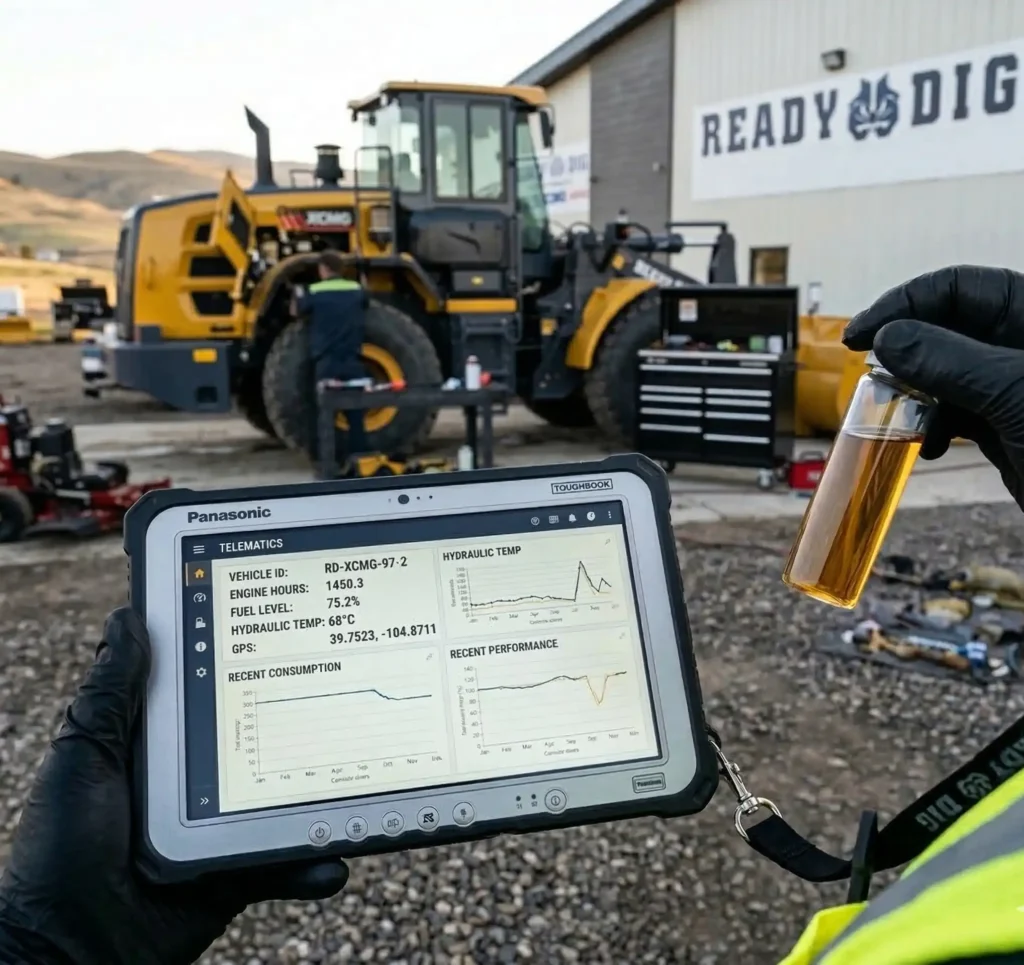
Leveraging Telematics and Fluid Analysis for Predictive Uptime
Fluid Analysis: The Diagnostic Blood Test
Fluid analysis is essentially a diagnostic blood test for your machinery. By sending samples of engine oil, hydraulic fluid, and coolant to a lab, you can detect microscopic wear metals (like iron from cylinder liners or copper from bearings) and contaminants (water or dirt). This lets you fix a failing component before it grenades the engine.Using Telematics Data to Validate Daily Inspections
Telematics bridge the gap between the field and the office. If an operator’s daily paper checklist says “fluids good,” but the telematics dashboard throws a high-temperature fault code, you know there is a discrepancy. Use telematics to track real-time engine hours, monitor idle times (which cause wet stacking), and automate your 250-hour service reminders.The ReadyDig Advantage: Compliance, Guarantees, and Dealer Support
How Regular Maintenance Protects the ReadyDig Uptime Guarantee
At ReadyDig, we back our rentals and sales with our exclusive Uptime Guarantee™. If a machine breaks down, we fix it within 24 hours or provide a loaner. However, this partnership goes two ways. Adherence to manufacturer-recommended daily checks and fluid schedules is required to keep warranties and guarantees valid. If you do your daily walk-arounds, we guarantee the machine will work as hard as you do.XCMG Maintenance: Durability and Service Life Expectations
We proudly supply XCMG equipment because it is engineered for brutal resilience. But even an XCMG wheel loader needs care. Because XCMG uses world-class components (like Cummins engines and Kawasaki hydraulics), maintaining clean fluids and adhering to the PM schedule ensures these machines will easily push past 10,000+ hours of service life in heavy earthmoving applications.Training Operators & Implementing Digital Tools
The best maintenance plan on paper is useless if the operator doesn’t care. Train your operators. They are your first line of defense. They know how the machine sounds, feels, and responds. Empower them to report issues without fear of slowing down the job. Finally, ditch the paper logbooks. Adopt a mobile-friendly CMMS (Computerized Maintenance Management System). Having operators complete digital daily checklists on their phones ensures the data is instantly uploaded, time-stamped, and visible to your fleet manager.Schedule a Fleet Service or Request Parts Today