
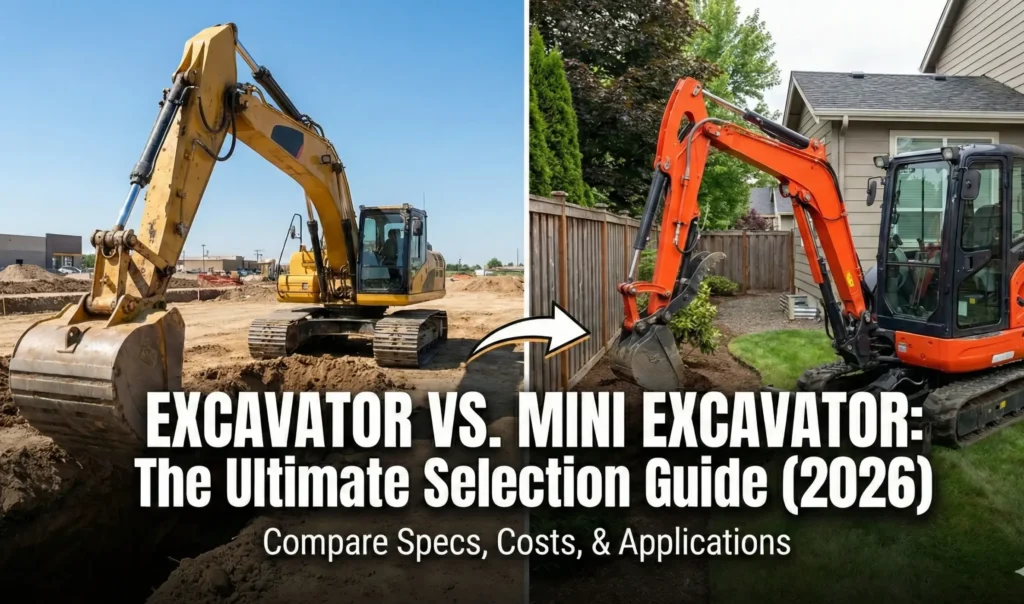
In the construction and landscaping world, choosing the right equipment isn’t just about horsepower it’s about efficiency, accessibility, and the bottom line.
Whether you are a general contractor bidding on a commercial site or a landscaper renovating a residential backyard, the choice between a standard excavator and a mini excavator can determine the profitability of your job.
Choose a machine that is too small, and you risk falling behind schedule due to lack of power.
Choose one that is too big, and you might damage the job site or blow your budget on rental fees. This guide breaks down the critical differences in specs, costs, and applications to help you make the right investment for 2026.
At ReadyDig, we see one factor drive real-world ROI more than spec sheets: uptime.
The “right” excavator is the one that fits your site and stays productive with predictable support when you need parts, service, or attachments. If uptime is a priority, explore our Uptime Guarantee™ program for eligible equipment.
Not sure about sizing specifics? Check out our detailed guide on how to choose the right excavator size for construction projects.
Quick Comparison: The Main Differences at a Glance
Before diving into the technical details, here is a high-level comparison of how these two machine categories stack up against each other.
| Feature | Mini Excavator (Compact) | Standard Excavator (Crawler) |
|---|---|---|
| Weight Class | 1 to 10 Tons | 10 to 90+ Tons |
| Horsepower | 10 – 75 HP | 100 – 500+ HP |
| Dig Depth | 5 – 15 Feet | 20+ Feet |
| Best Application | Residential, Utilities, Tight Spaces | Commercial Sites, Roadwork, Deep Trenching |
| Transport | Trailer + Pickup Truck | Low-boy Trailer (Often CDL Required) |
What is a Standard Excavator?
Often referred to as “crawlers” or “diggers,” standard excavators are the heavy lifters of the industry.
These machines typically start around 13 tons and scale up into high-production classes designed for demanding commercial and infrastructure work.
Key Specs and Capabilities
Standard excavators are defined by raw power.
With engines ranging from 100 to 500+ HP, they handle the jobs that compact machines physically cannot touch. Models like the XE210U or the larger XE360U are designed to dig to depths exceeding 20 feet and have the dump height required to load high-walled dump trucks efficiently.
Ideal Applications
These machines are the standard choice for:
- Commercial Construction: Digging foundations for large buildings and site development.
- Road Building: Moving massive amounts of earth for grading and utilities.
- Demolition: Tearing down structures using heavy-duty attachments such as severe duty cutters.
- Deep Trenching & Mass Excavation: High-volume production where cycle time matters.
If you need high-production capability, browse our full inventory of standard excavators for sale.
What is a Mini Excavator?
Mini excavators (or compact excavators) weigh between 1 and 10 tons.
They have surged in popularity over the last decade due to their versatility and the increasing need for construction in congested urban and residential areas.
Key Specs and Capabilities
While they lack the brute force of their larger cousins, mini excavators excel in precision.
Many feature retractable undercarriages that allow them to squeeze through standard 39-inch gates, and zero-tail swing designs (like the XE35U) that prevent the rear of the cab from hitting obstacles while rotating.
Ideal Applications
Mini excavators are the go-to choice for:
- Residential Landscaping: Digging pools, ponds, or removing stumps without destroying the lawn.
- Utility Work: Installing pipes or cables in narrow alleys and easements.
- Indoor Demolition: Fitting inside buildings to break up concrete floors.
- Farming: General maintenance and fence post digging.
Looking for a compact solution? View our mini excavator rental options.
Detailed Comparison: Performance and Logistics
1. Power, Breakout Force, and Reach
If your project involves digging through frost, clay, or rock, the standard excavator is superior.
The higher hydraulic flow supports heavier-duty attachments and faster production. However, for surface-level trenching (water lines, electrical) and light-to-medium digging, a mini excavator often provides sufficient power with significantly better fuel economy and less site disruption.
2. Attachments and Versatility
One of the biggest advantages of both machines is their ability to swap tools.
However, the scale differs greatly.
Mini Excavators commonly run tools like auger drives for fencing or brush cutters for clearing overgrowth.
Standard Excavators can power larger tools such as hydraulic hammers, crushers, and high-capacity buckets for commercial production work.
Dealer Tip: Attachment performance depends on proper sizing (hydraulic flow/pressure, coupler fitment, and weight balance).
If you are unsure, ReadyDig can help match the attachment to the machine so you avoid slow cycle times or premature wear.
3. Transportation and Logistics
Logistics is often the hidden cost of excavation.
- Mini Excavators: Many units under 10,000 lbs can be towed behind a heavy-duty pickup truck on a standard equipment trailer.
- Standard Excavators: These often require a commercial semi-truck and a low-boy trailer (plus loading/unloading planning).
Important Regulatory Note: Transporting a standard excavator often requires a driver with a CDL (Commercial Driver’s License).
According to the FMCSA, vehicles with a Gross Combination Weight Rating of 26,001 pounds or more require a Class A CDL. You may also need oversize load permits depending on weight, width, and route.
Cost Analysis: Rental vs. Ownership
Rental Rate Comparison
For short-term jobs, rental rates vary by region, but typical daily ranges suggest:
- Mini Excavator: $350 – $850 per day.
- Standard Excavator: $1,000 – $3,000 per day.
If you want to validate size and performance before committing to a purchase, ReadyDig’s rent-to-own program (rent-to-purchase) can be the smartest path: put the machine to work first, confirm it fits your projects, then apply payments toward ownership.
Operating Costs and TCO
If you are looking to buy, consider the Total Cost of Ownership (TCO) not just the purchase price.
Fuel: A mini excavator sips fuel, often running a full day on less than 15 gallons.
A large excavator can burn that in an hour under load.
Maintenance: Larger machines have higher fluid capacities and more expensive undercarriage parts.
For reliable upkeep, our parts and services department can help you estimate maintenance schedules.
Downtime (Often the Biggest Cost): A machine that sits waiting for parts or service can quietly erase savings.
That’s why many contractors prioritize dealer-backed support especially for high-utilization fleets. For eligible equipment, ReadyDig’s Uptime Guarantee™ is designed to reduce downtime risk and protect project timelines.
Decision Matrix: How to Choose?
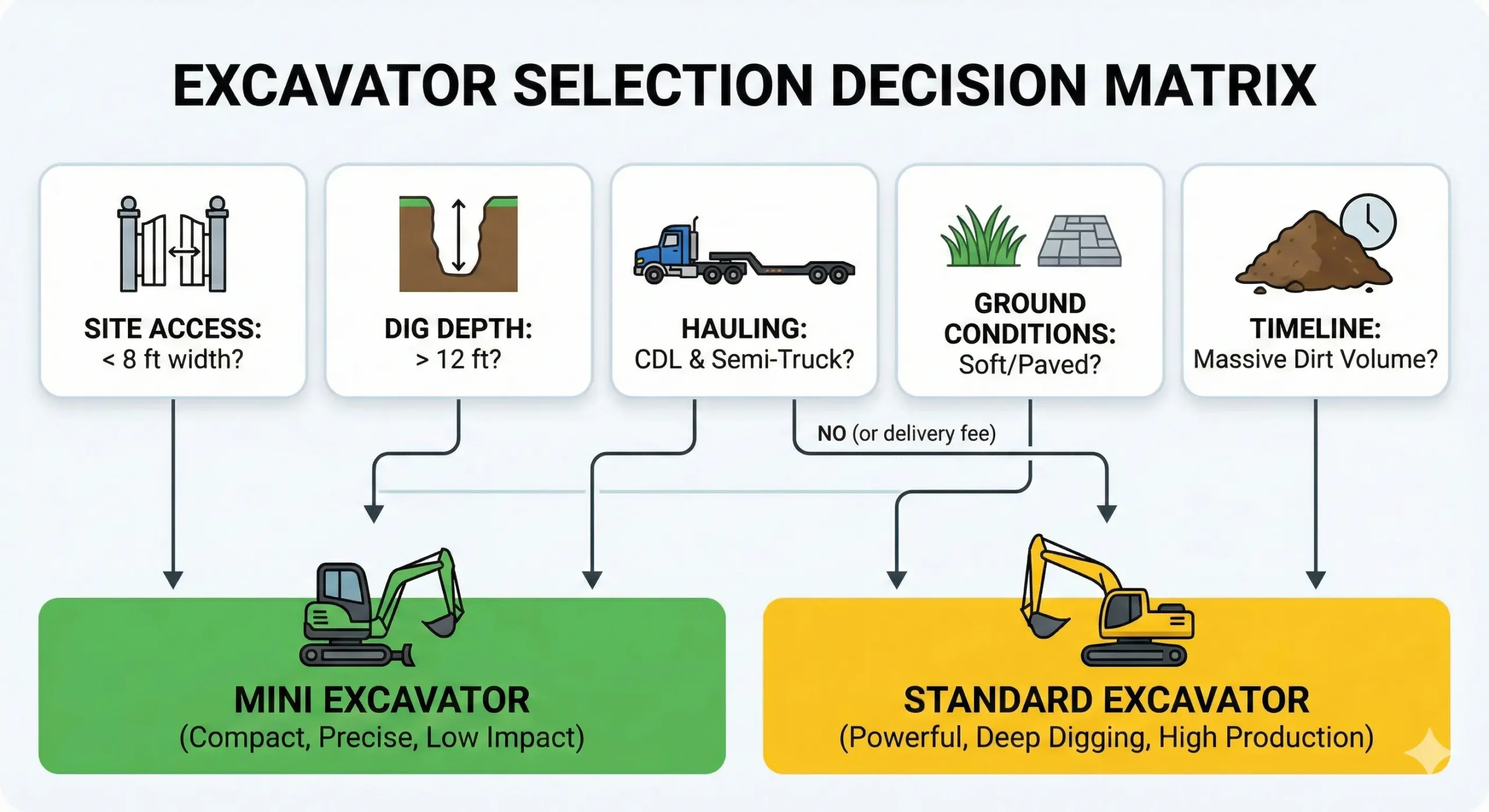
Still on the fence? Use this checklist to make your final decision:
- Site Access: Is the entry width less than 8 feet? → Choose Mini.
- Dig Depth: Do you need to dig deeper than 12 feet? → Choose Standard.
- Hauling: Do you have a CDL driver and a semi-truck? → If no, choose Mini (or factor in delivery fees).
- Ground Conditions: Is the ground soft, finished, or paved? → Choose Mini (rubber tracks).
- Timeline: Is the volume of dirt massive? → Choose Standard (speed justifies the cost).
Frequently Asked Questions
What is the main difference between a mini excavator and a standard excavator?
The primary differences are size, weight, and power.
Mini excavators typically weigh between 1 and 10 tons and are designed for tight spaces. Standard excavators weigh over 13 tons, offer higher horsepower, and are used for heavy-duty digging.
Do I need a special license to operate a mini excavator?
In many jurisdictions, you can operate a mini excavator on private property without a special license, though specific training/certification is recommended for safety.
Be sure to check OSHA excavation standards regarding trench safety and competent person requirements regardless of machine size.
Can mini excavators be used for demolition?
Yes for light and indoor demolition.
Their compact size allows them to fit through doorways. However, for structural demolition of large buildings, a standard excavator is typically required.
Which excavator is better for residential landscaping?
A mini excavator is generally better.
They have a lighter footprint that causes less damage to lawns and can maneuver around houses and fences far easier than a standard machine.
Should I rent first or buy right away?
If your projects vary (or you are unsure about size), renting first is often the lowest-risk decision.
Many contractors use a rent-to-purchase approach to test performance in real conditions before committing to ownership.
ReadyDig offers a rent-to-own option that can reduce risk and protect cash flow.
Conclusion
There is no “better” machine only the right machine for the job.
If you are moving mountains, digging deep foundations, or clearing large tracts of land, the standard excavator is the productivity king.
However, for utility work, backyard renovations, and jobs where access is limited, the mini excavator offers an ideal balance of power, precision, and low site impact.
Ready to get to work? Contact us today for a quote on your next rental or purchase, or browse our full selection of heavy equipment for sale.